Book: Atonement and Reconciliation
On what basis can a holy God forgive sin?
New – an app is in the works! This is an online database reference source with hundreds of Bible verses and other topics related to atonement. Click on the appsheet link below to use this app.
The following is a very CONDENSED version of Chapter 1.
“Shall I give my firstborn for my transgression, the fruit of my body for the sin of my soul?” He has told you, O man, what is good; and what does the LORD require of you but to do justice, and to love kindness, and to walk humbly with your God?” Micah 6:7b-8
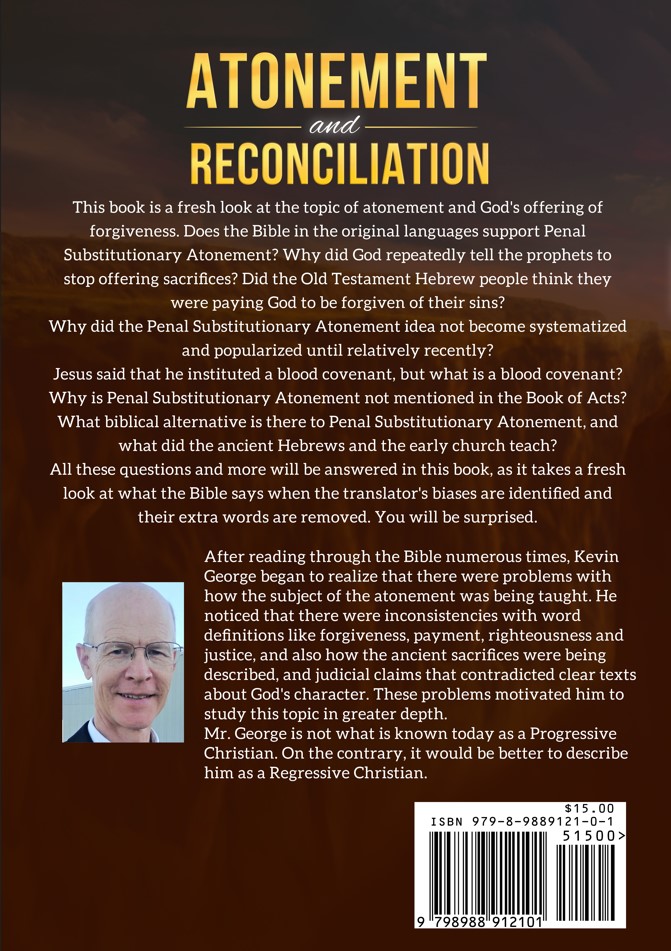
On what basis does a holy God offer forgiveness for our sins so we can have a right standing before Him? We all want forgiveness, and a misunderstanding or lack of feeling forgiven can generate an erroneous method of seeking it, leading to horrible consequences such as self-immolation and even child sacrifices. For the last 500 to 1000 years, Protestant Christianity has offered an explanation of how God forgives, called Penal Substitutionary Atonement. This view frames the atonement in legal terms, with God as a judge in a courtroom.
Many critics now question the penal substitution teaching, as it claims that God would not, or could not, forgive our sins unless and until men tortured and murdered His innocent son, thereby somehow paying Him for humanity’s sin debt in order to meet an infinite perfection of justice. The doctrine is taught as a loving God who provides a willing substitute to take our place in punishment and death, so that He can now accept sinful humanity.
This book examines Penal Substitutionary Atonement (abbreviated as PSA), and will provide a biblical explanation of an alternative view which this author calls Reconciliational Atonement, or, Repentance and Reconciliation Atonement, or, Relational Atonement. Not all churches within what is generically called “Christianity” teach Penal Substitutionary Atonement, as it is predominantly a Protestant doctrine. The Catholic and Greek Orthodox churches are exceptions, mentioned in Chapter 2. Nevertheless, the prevailing view within much of Christianity today is some form of PSA, with various nuances or emphasis in different groups.
This book will briefly review the most common atonement teachings throughout church history. Then Penal Substitutionary Atonement (PSA) will be examined logically and biblically and other atonement factors will be considered. Finally, essential scripture passages will be investigated. Reconciliational Atonement results in ceasing from sin, living godly lives, and becoming reconciled to God.
The goal of this author is to grasp a biblical teaching of atonement that fits the Old and New Testament texts within their original cultural, textual, historical, and linguistic context. This means attempting to comprehend ancient Hebraic thought and background cultural norms. This is important because interpreting the biblical texts within foreign frameworks will cause confusing theological claims that are often slippery, contradictory, and even absurd.
A good example of confusion when interpreting the biblical texts with a foreign framework is seen in books written by Leon Morris. His first book, entitled “The Apostolic Preaching of the Cross,” is often been held up as one of the best scholarly works of a detailed linguistic analysis of the key words used in defense of PSA, in which he rejects the use of redemption as a metaphor. But about 20 years later, in his second book, “The Atonement,” he switches views, concluding that it often is used as a metaphor! This demonstrates how scholars have struggled with the meaning of words related to the topic of atonement. Perhaps part of this is because they are starting with the wrong presuppositions, leading to illogical claims that can never be resolved. What if their presuppositions are replaced with concepts that made sense to the original Hebrew people, and we move on from there instead of front-loading the topic with predetermined conclusions?
This journey begins in the next chapter with a brief examination of various theories of atonement that have been proposed throughout church history.
This book emphasizes the fact that the God of the Bible is very relational, much more so than being obsessed with legal demands. Do not miss this perspective!
Contents:
1. The Need To Know – Am I Forgiven?
2. A Brief History
3. Biblical & Logical Problems
4. Practical Consequences Of PSA
5. Roadmap To Resolution
6. Bible Covenants
7. Biblical Atonement
8. Faith, Grace, And Works
9. Biblical Justification And Righteousness
10. Ransom, Redemption, And Purchase
11. Sin, Filthy Rags, Propitiation, And Expiation
12. A New Look At Old Texts
13. Reconsidering Isaiah 53
14. The Gospels And Atonement Passages
15. Acts Atonement Passages
16. Romans 1 And 2 Atonement Passages
17. Romans 3 And Atonement Passages
18. Romans 4 Atonement Passages
19. Romans 5 Atonement Passages
20. Romans 6 Atonement Passages
21. Romans 7-8 Atonement Passages
22. Corinthian Atonement Passages
23. Galatians Atonement Passages
24. Ephesians Atonement Passages
25. Colossians To Titus Atonement Passages
26. Hebrews Atonement Passages
27. The Book Of James: Faith And Works Equals Justification
28. Peter’s Atonement Passages
29. 1 John Atonement Passages
30. Revelation And Atonement Passages
Appendix A – Reasons Why Jesus Died
Appendix B – Romans, Righteousness In Covenant?
Appendix C – Book Review, Justified – God’s Plan And Paul’s Vision
Appendix D – Book Review, Atonement And The Death Of Christ
Appendix E – Book Review, The Gospel According To Paul
User Data Policy: We do not collect any user data on this site or any app related to this site. We do not target a children audience under age 13.
Contact the author at: atonementandreconciliation@gmail.com
 Atonement and Reconciliation